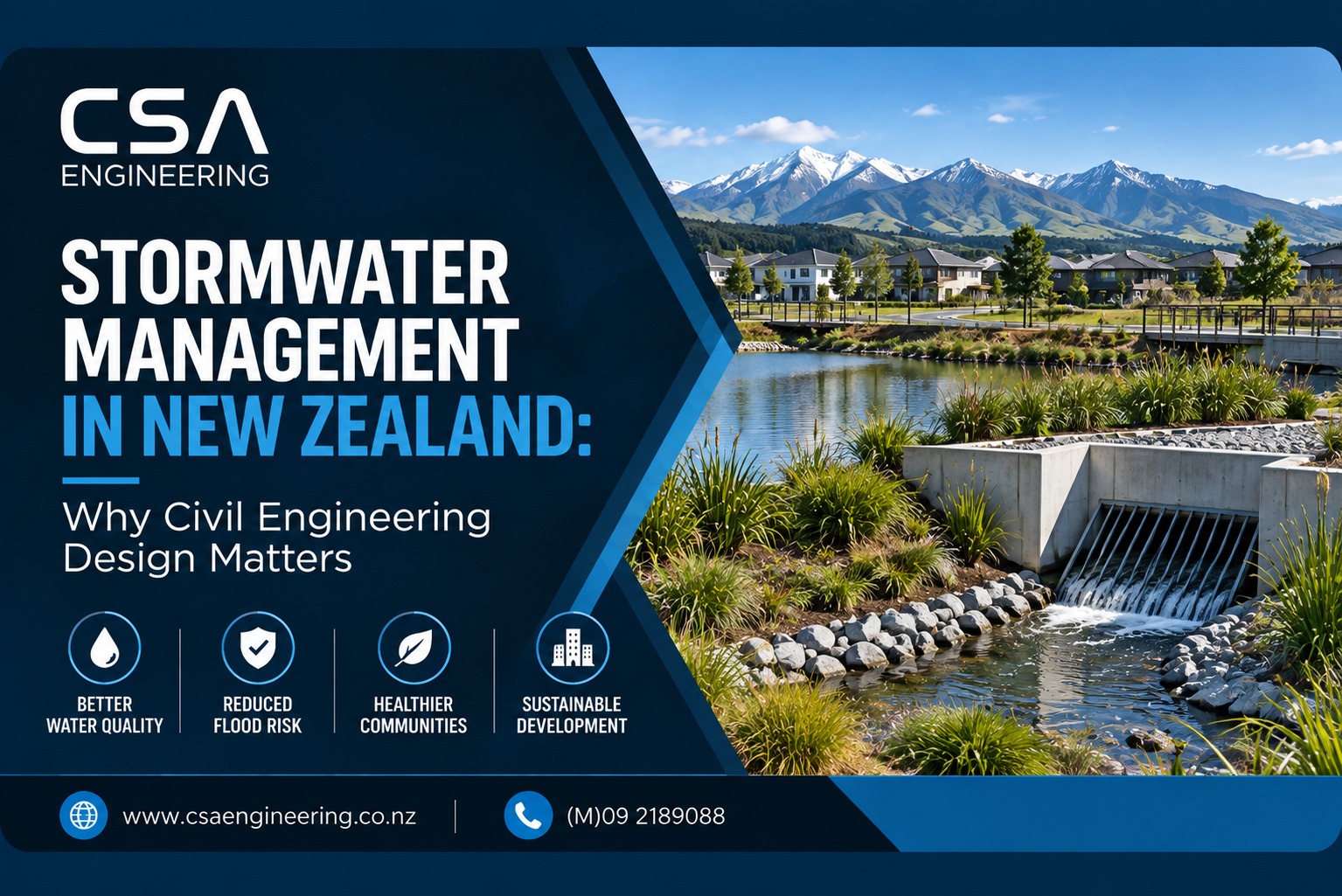
New Zealand’s weather has never been predictable, but the intensity of recent rainfall events has made one thing clear: sites that were fine ten years ago are not always fine today. Councils across Auckland, Wellington, and Christchurch have tightened stormwater requirements, and developers who treat drainage as an afterthought are the ones facing rejected consents and costly redesigns.
Stormwater management in New Zealand is no longer just a compliance checkbox. It is a core part of civil engineering design that determines whether a site floods, whether a building consent gets approved, and whether a development performs well for decades after the last truck leaves the site.
This article looks at why proper stormwater management matters, what New Zealand standards require, and how sound civil engineering design protects both property and people.
What Is Stormwater Management in Civil Engineering?
| Featured Snippet Answer: Stormwater management is the engineering process of planning, analysing, and designing infrastructure to capture, convey, treat, store, and safely discharge rainwater runoff from a developed site. In New Zealand, it covers everything from pipe networks and detention tanks to raingardens and overland flow paths, and it is a required part of civil engineering design for almost every subdivision, commercial site, and residential development. |
Every time rain falls on a roof, driveway, or car park, that water has to go somewhere. Before a site is developed, rainfall soaks into soil and vegetation naturally. Once you add roofs, concrete, and compacted ground, that natural absorption disappears, and runoff volumes increase sharply. Left unmanaged, this extra water causes surface flooding, erosion, and pressure on downstream council infrastructure that was never built to handle it.
Good stormwater engineering replicates, as closely as possible, the way water moved across a site before it was built on. That is the entire purpose of civil engineering design in this space: manage the change, not just the symptom.
Why Stormwater Management Matters More in New Zealand Right Now
Three factors make this a bigger issue in New Zealand than it was a decade ago.
Rainfall Intensity Is Increasing
Climate projections from NIWA point to more frequent high-intensity rainfall events across most of the country. Councils have responded by updating design storm data, which means stormwater systems designed on old rainfall figures may already be undersized for what a site will actually experience.
Land Development Is Accelerating
Subdivision activity in Auckland, Waikato, and other growth regions continues to add hard surfaces to catchments that already struggle during heavy rain. Every new roof and driveway adds runoff that has to be accounted for somewhere in the design.
Councils Are Enforcing Stricter Standards
Auckland Council’s GD01 and GD04 guidance, along with growing adoption of Water Sensitive Design principles, means consent authorities are asking harder questions about detention volumes, treatment devices, and overland flow paths than they were a few years ago.
Together, these pressures mean a stormwater design that would have sailed through consent in 2015 can get sent back for revision today. This is exactly where proper civil engineering services make the difference between a smooth consent process and months of delay.
Why Civil Engineering Design Is Central to Effective Stormwater Systems
Stormwater problems are rarely about a single missing pipe. They are usually design problems that surface only after the concrete is poured.
Hydraulic Modelling Prevents Undersized Systems
Civil engineers use hydraulic modelling to calculate expected runoff volumes based on catchment area, surface type, and rainfall intensity for a given storm event. Without this modelling, pipe sizes and detention volumes are guesswork, and guesswork tends to fail during the storm that matters most.
Detention and Retention Systems Manage Peak Flows
Detention tanks, retention ponds, and attenuation devices slow the rate at which water leaves a site, matching post-development discharge rates to what the downstream network was designed for. Getting the volume and outlet control right requires engineering calculation, not a standard product picked off a shelf.
Overland Flow Paths Handle the Extremes
Every stormwater system has a design limit. Good civil engineering design plans for what happens when rainfall exceeds that limit, directing overland flow safely away from buildings rather than letting it pond against foundations or flow into neighbouring properties.
Site Grading Determines Everything Downstream
Subtle grading mistakes, a driveway sloped the wrong way, a low point near a garage, can undo an otherwise well-designed pipe network. This is why stormwater design has to be integrated with broader land development engineering, not treated as a separate task bolted on at the end.
Council Compliance and New Zealand Standards
Stormwater design in New Zealand sits within a defined regulatory framework, and consent authorities expect documentation that demonstrates compliance, not just good intentions.
Key references include:
- NZ Building Code Clause E1 – Surface Water, covering the basic performance requirements for stormwater disposal.
- NZS 4404 – Land Development and Subdivision Infrastructure, which sets out infrastructure design standards used across most territorial authorities.
- Auckland Council Stormwater Code of Practice and the GD01/GD04 guidance documents, which govern water sensitive design and stormwater management for the Auckland region specifically.
- Resource Management Act requirements around stormwater discharge, which often trigger the need for resource consent alongside building consent.
Meeting these standards typically requires hydraulic calculations, stormwater management plans, and Engineering Approval Plan documentation prepared to a level of detail councils can assess quickly. Projects with more complex catchments or flood-prone sites also benefit from dedicated flood management and hydraulic design assessment, particularly where overland flow paths cross multiple properties or council infrastructure has known capacity constraints.
Common Stormwater Mistakes That Cost Developers Time and Money
- Sizing pipes on assumptions rather than modelling – leads to systems that surcharge during moderate storms.
- Ignoring overland flow paths – creates flooding risk during events larger than the design storm.
- Underestimating detention volumes – results in council rejection or expensive post-approval redesign.
- Treating stormwater as separate from earthworks and grading – causes conflicts between finished levels and drainage falls discovered only during construction.
- Leaving stormwater design until late in the process – narrows the options available and increases both design and construction cost.
Each of these mistakes is avoidable with early engineering input. Coordinating stormwater design alongside earthworks and site development engineering from the concept stage, rather than after a concept plan is locked in, consistently produces better outcomes and fewer consent iterations.
Stormwater Management for Subdivisions and Larger Developments
Subdivisions carry additional complexity because stormwater from multiple future lots has to be managed as a single coordinated network rather than site by site. A subdivision-wide stormwater strategy typically needs to account for staged development, shared detention infrastructure, and long-term maintenance responsibility once lots are sold individually.
This is where dedicated subdivision engineering services add real value. Engineers assess the full catchment, design shared stormwater infrastructure that will still perform correctly once all lots are built out, and prepare the documentation councils need to approve infrastructure that will serve multiple future owners.
The Practical Value of Getting Stormwater Design Right the First Time
Well-designed stormwater infrastructure is invisible when it works. Pipes carry water away, detention systems fill and drain as intended, and overland paths sit dry except during major storms. That invisibility is the entire point.
The cost of getting it wrong shows up later, in flooded driveways, damp foundations, disputes with neighbours over redirected runoff, or council enforcement action against non-compliant discharge. Compared against those outcomes, the cost of proper hydraulic modelling and engineering design at the front end of a project is modest.
For developers and property owners, the practical takeaway is straightforward: bring engineering input into stormwater planning early, size systems against real rainfall data rather than assumptions, and treat council standards as a design baseline rather than a hurdle to clear at the last minute.
Conclusion
Stormwater management in New Zealand has moved well beyond simply connecting a pipe to the street. Rising rainfall intensity, tighter council standards, and the scale of ongoing land development mean that stormwater systems now need to be engineered with the same rigour as the buildings they protect. Sound civil engineering design, backed by proper hydraulic modelling, realistic detention sizing, and clear overland flow planning, is what keeps developments safe, compliant, and free of expensive surprises after construction. Whether the project is a single residential lot or a multi-stage subdivision, getting stormwater management design right from the concept stage remains one of the most cost-effective decisions a developer can make.
Frequently Asked Questions
What is stormwater management design?
Stormwater management design is the engineering process of planning drainage infrastructure, including pipes, detention systems, and treatment devices, to safely capture and discharge rainwater runoff from a developed site while meeting council requirements.
Why is stormwater management important in New Zealand?
It reduces flooding risk, protects infrastructure and neighbouring properties, improves water quality, and is required for building and resource consent approval across New Zealand councils.
Do I need resource consent for stormwater discharge?
In many cases, yes. Resource consent is often required for stormwater discharge, earthworks, and land development activities where the site or catchment triggers council thresholds. A civil engineer can confirm what applies to a specific site.
What New Zealand standards apply to stormwater design?
Common references include NZ Building Code Clause E1, NZS 4404, Auckland Council’s Stormwater Code of Practice, and GD01/GD04 guidance for water sensitive design.
What happens if stormwater is not properly managed on a site?
Poorly managed stormwater can cause surface flooding, erosion, foundation damage, disputes over redirected runoff, and council enforcement action for non-compliant discharge.
How early should stormwater design start in a project?
Ideally at concept stage, alongside earthworks and site layout planning, since grading, detention sizing, and overland flow paths all influence and are influenced by the broader site design.
Internal Links Used
| Anchor Text | Destination URL | Reason for Linking |
| stormwater management design | https://csaengineering.co.nz/stormwater-management/ | Primary service page for the article’s core topic; reinforces topical relevance for the target keyword. |
| civil engineering services | https://csaengineering.co.nz/civil-engineering/ | Links to the parent service hub, supporting topical authority for the broader civil engineering category. |
| land development engineering | https://csaengineering.co.nz/land-development-engneering/ | Connects site grading discussion to the related land development service. |
| flood management and hydraulic design | https://csaengineering.co.nz/flood-management-hydraulic-design/ | Relevant for complex catchments and flood-prone sites referenced in the compliance section. |
| earthworks and site development engineering | https://csaengineering.co.nz/earthworks-site-development-engineering/ | Supports the point on coordinating stormwater design with earthworks from concept stage. |
| subdivision engineering services | https://csaengineering.co.nz/subdivision-engineering-services/ | Directly relevant to the subdivision-specific section of the article. |