Introduction
Planning a new build, extension, or subdivision in New Zealand almost always means dealing with council paperwork before a single spade goes into the ground. Two terms come up constantly: resource consent and building consent. They sound similar, and confusingly, a single project can need one, the other, or both. Understanding the difference between resource consent vs building consent NZ requirements early can save weeks of delay and thousands of dollars in redesign costs.
This guide breaks down what each consent actually covers, when you need them, how long they take, and what happens if you skip a step you shouldn’t have. Whether you’re a homeowner adding a granny flat, a developer subdividing land, or a business fitting out commercial premises, knowing the difference is the first step toward a smooth council approval process.
What Is Resource Consent in New Zealand?
Resource consent is permission granted under the Resource Management Act 1991 (RMA) to carry out an activity that isn’t automatically allowed under your local council’s district or regional plan. It has nothing to do with the physical construction itself. Instead, it deals with how land is used and what effect that use has on neighbours, waterways, traffic, or the wider environment.
Every council area in New Zealand operates under a district plan and, in some cases, a regional plan. These plans zone land for particular uses and set rules around building height, boundary setbacks, site coverage, and stormwater discharge. If your proposal fits within those rules, it’s a permitted activity and no resource consent is needed. Step outside them, and you’ll need council sign-off before you can proceed.
When You Need Resource Consent
Common situations that trigger the need for resource consent include:
- Subdividing a section into two or more titles
- Building closer to a boundary than the district plan allows
- Exceeding maximum height or site coverage limits
- Removing significant trees or vegetation
- Earthworks near waterways or on sloped or unstable land
- Commercial activities proposed in a residential zone
Subdivision is one of the most common resource consent triggers CSA Engineering deals with, particularly for landowners looking to create additional titles from an existing property. If you’re planning to subdivide, our subdivision engineering services cover the survey, drainage, and design work that typically forms part of the resource consent application itself.
What Is Building Consent in New Zealand?
Building consent is a separate approval, issued under the Building Act 2004, that confirms your building work will comply with the New Zealand Building Code (NZBC). Where resource consent is concerned with land use and environmental effects, building consent is concerned with the physical safety, structure, weathertightness, and performance of the building itself.
You cannot legally start most building work without it. Councils, acting as Building Consent Authorities, review architectural and structural drawings, engineering calculations, and specifications before issuing consent. Once building consent is issued, the council also carries out inspections during construction and issues a Code Compliance Certificate (CCC) once the work is finished and compliant.
When You Need Building Consent
Most construction work needs building consent, including:
- New homes, sleepouts, and granny flats over a certain size
- Structural alterations, including removing load-bearing walls
- Re-roofing, re-cladding, or major renovations
- Retaining walls over 1.5 metres, or supporting a surcharge
- Decks over 1.5 metres high
- Commercial fit-outs and change of building use
Because building consent hinges on structural compliance, getting the engineering right the first time matters. CSA Engineering’s structural engineering and building design team prepares the calculations and documentation councils expect to see, which reduces the back-and-forth that causes most delays.
Resource Consent vs Building Consent: The Key Differences
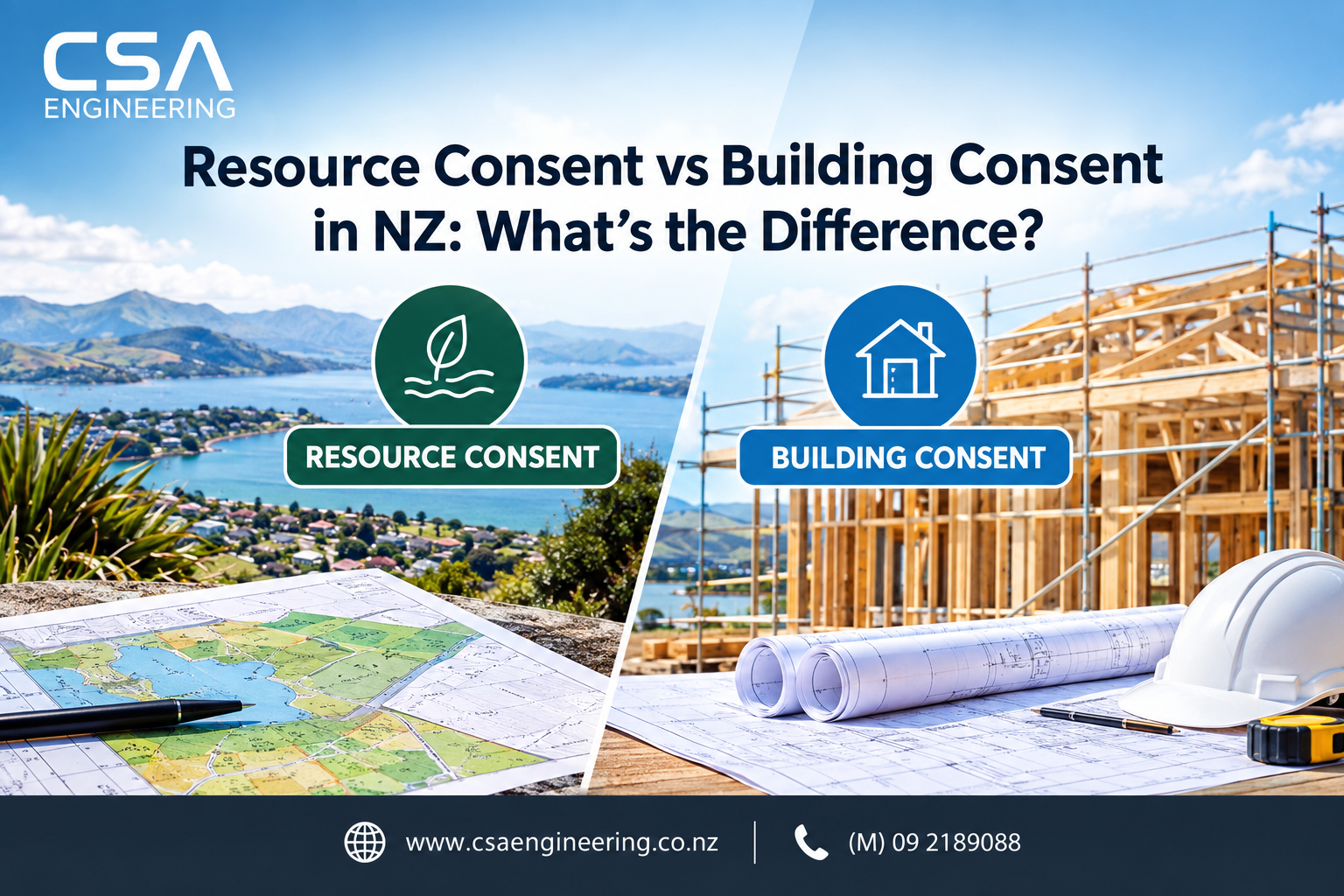
Quick answer: resource consent deals with how land is used and its effects on the environment under the RMA, while building consent confirms the construction itself is safe and compliant with the NZ Building Code under the Building Act 2004. A single project can need one, the other, or both, and they are assessed separately, sometimes by different teams within the same council.
| Aspect | Resource Consent | Building Consent |
| Governing law | Resource Management Act 1991 (RMA) | Building Act 2004 |
| What it covers | Land use and effects on the environment | Structural safety and Building Code compliance |
| Assessed by | Council planning team | Building Consent Authority (BCA) |
| Common triggers | Subdivision, boundary breaches, earthworks, zoning non-compliance | New builds, renovations, structural changes, re-cladding |
| Typical processing time | ~20 working days (non-notified applications) | ~20 working days once application is accepted |
| Outcome | Consent granted with conditions | Consent, followed by a Code Compliance Certificate (CCC) |
Do You Need Both Resource Consent and Building Consent?
Yes, frequently. A common example: subdividing a section to build a second dwelling usually needs resource consent for the subdivision itself, and a separate building consent for the new dwelling’s construction. The two applications run on different timelines and are assessed against different rules, so sequencing matters.
In most cases, resource consent should be resolved first, since it can affect where and how a building sits on the site, including setbacks and coverage. Applying for building consent before resource issues are settled risks a redesign partway through. This is one of the main reasons projects stall, and it’s where coordinated council consent and compliance support from an experienced engineering team makes a measurable difference to project timelines.
What Happens If You Build Without the Right Consent?
Building or developing without the required consent isn’t a minor paperwork issue. Councils can issue notices to stop work, require retrospective consent applications that cost more and aren’t guaranteed to succeed, or in serious cases order remedial work. Unconsented work also creates problems at resale, since buyers’ lawyers and banks routinely check LIM reports for consent history. A structure built without the right consent can become difficult to sell, or sellable only at a discount, until the issue is resolved.
How Long Does Each Consent Take?
Building consent applications have a statutory processing time of 20 working days once the council accepts the application as complete, though the clock stops if the council issues a request for further information, which is the single biggest cause of delay. Resource consent follows a similar 20 working day standard for non-notified applications, but notified applications, where neighbours or the public can make submissions, can extend the process by several months. Well-prepared applications with complete documentation rarely trigger information requests, which is why accuracy at the application stage matters more than speed.
How to Avoid Delays With Council Approvals
Most consent delays come down to incomplete or poorly coordinated documentation, not the underlying project itself. A few practical steps help:
- Get a Project Information Memorandum (PIM) early to flag site-specific issues like flood hazards or existing consents
- Coordinate architectural, structural, and civil drawings before lodging, so they don’t contradict each other
- Confirm zoning and district plan rules before finalising the design, not after
- Budget time for stormwater and earthworks assessments on sloped or subdivided sites
For larger or more complex sites, involving civil engineering and land development engineering expertise from the concept stage typically prevents the redesigns that cause the longest hold-ups. CSA Engineering coordinates this documentation across disciplines so councils receive a complete, consistent application the first time.
Conclusion
Resource consent and building consent solve two different problems: one manages how land is used, the other confirms what gets built on it is safe and compliant. Getting the resource consent vs building consent NZ distinction right from the outset, and understanding which one, or both, your project needs, is what keeps timelines realistic and budgets intact. Whether you’re planning a subdivision, a new home, or a commercial development, working with a team that understands both processes reduces the risk of costly surprises partway through. If you’re unsure which consents your project needs, CSA Engineering’s council consent and compliance support team can review your plans and map out the approval pathway before you lodge anything.
FAQ
What is the main difference between resource consent and building consent in NZ?
Resource consent covers land use and environmental effects under the RMA. Building consent covers the physical construction and its compliance with the NZ Building Code under the Building Act 2004.
Do I need resource consent to build a house?
Not always. If your house fits within your district plan’s permitted activity rules for height, setbacks, and coverage, you may only need building consent. A non-compliant design needs resource consent as well.
Can I apply for building consent and resource consent at the same time?
In some cases the two can run concurrently, but it’s generally safer to resolve resource consent issues first, since they can affect the building design itself.
How long does a resource consent take in New Zealand?
Non-notified applications typically take around 20 working days. Notified applications, where the public can make submissions, can take considerably longer.
Does a granny flat need resource consent or building consent?
Most granny flats need building consent. Resource consent may also be required if the unit affects site coverage, setbacks, or creates an additional household unit not provided for in the district plan.
What happens after building consent is granted?
Construction can begin, subject to inspections at key stages. Once the work is complete and passes final inspection, the council issues a Code Compliance Certificate (CCC).