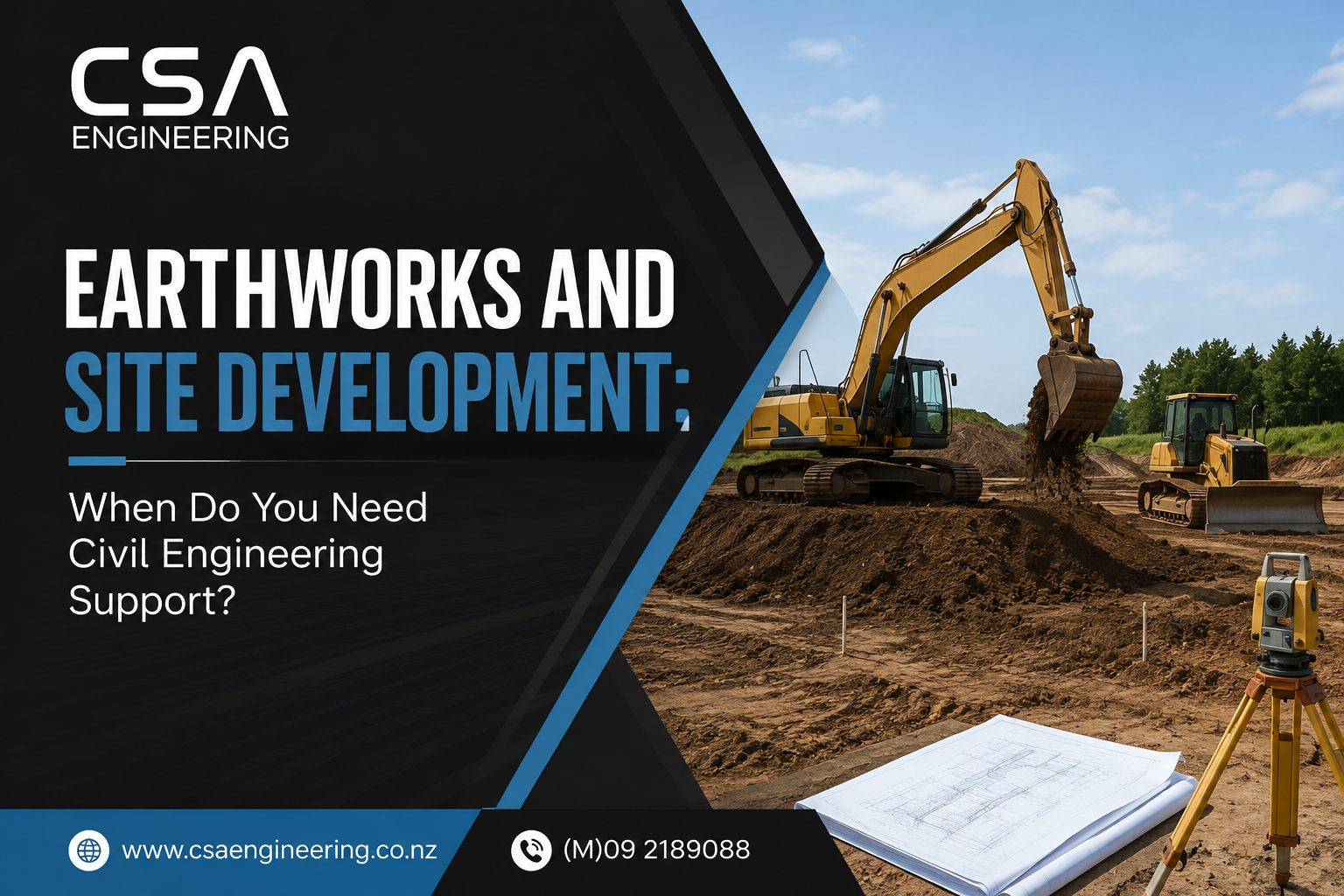
Earthworks and Site Development: When Do You Need Civil Engineering Support?
Every construction project starts with the ground beneath it. Before a foundation is poured or a driveway is laid, the land itself has to be shaped, levelled, and made safe to build on. This is where earthworks and site development engineering comes in, and it is also where many property owners run into trouble by assuming a digger and a good contractor are all they need.
The truth is that earthworks and site development engineering is a technical discipline with real consequences for safety, drainage, and council approval. Knowing when to bring in civil engineering support, rather than after a problem appears, can save a project from delays, rework, and unexpected costs.
This guide breaks down what earthworks and site development actually involves, the warning signs that indicate you need professional engineering input, and how the right support keeps your project compliant and on schedule.
What Is Earthworks and Site Development Engineering?
Earthworks and site development engineering covers the planning, analysis, and design work required to prepare land for construction. This includes site grading, cut and fill calculations, retaining structures, drainage coordination, and other landform changes needed to create a stable, buildable site.
In practical terms, it answers questions like: How much soil needs to move? Where does that soil go? Will the finished platform drain properly? Does the slope need retaining? Every one of these questions has engineering implications, and getting them wrong can affect everything built afterward.
CSA Engineering’s earthworks and site development engineering services in New Zealand deliver practical, construction-ready solutions tailored to project-specific site conditions and development objectives, which is a fair summary of what good site engineering should achieve: not just moving dirt, but making sure the finished site actually works.
Why Site Development Cannot Be Left to Guesswork
Land is rarely flat, uniform, or predictable. Two neighbouring sites can have completely different soil types, water tables, and slope stability. A contractor working from a rough plan, without engineering calculations behind it, is essentially guessing at how the site will behave once construction loads and rainfall are added to the equation.
Poor site preparation shows up later as cracked slabs, pooling water, slumping retaining walls, or a building consent application that gets rejected outright. According to Engineering New Zealand, ground and geotechnical issues remain one of the most common causes of construction defects and cost overruns nationally, which is exactly why councils require engineering documentation before approving most site works.
Signs You Need Civil Engineering Support for Earthworks
Not every backyard levelling job needs a full engineering report. But several situations make professional involvement essential rather than optional.
You Are Planning a Subdivision
Subdivisions almost always require formal earthworks design, drainage integration, and consent documentation. CSA Engineering’s civil engineering team delivers comprehensive solutions for infrastructure, land development, transport systems, drainage, and public works projects, which is the kind of coordinated approach subdivisions demand, since earthworks, stormwater, and access all need to work together. Our subdivision engineering services are built specifically around this coordination.
Your Site Has a Slope or Retaining Requirement
Any site with meaningful grade change needs an engineer to assess slope stability and design retaining structures. Retaining walls carry real structural loads, and an undersized or poorly positioned wall can fail, sometimes catastrophically, during heavy rain.
You Need Council Consent
Most earthworks projects in New Zealand require some form of council approval. As outlined on our earthworks page, common pathways include Resource Consent for land development activities, Building Consent for compliance verification, and detailed engineering documentation for council review. Without an engineer preparing this paperwork correctly, applications are frequently delayed or declined.
Drainage and Stormwater Are Involved
Changing site levels changes where water goes. If your earthworks affect natural drainage paths, you likely need a coordinated approach between site grading and stormwater management design to avoid flooding your own site or a neighbour’s.
You Are Building on Fill or Uncertain Ground
If part of your site includes filled ground, reclaimed land, or unknown subsurface conditions, soil testing and geotechnical assessment become essential before any building platform is designed.
The Project Involves Commercial or Industrial Loads
Heavier structures and vehicle loading demand more rigorous cut and fill analysis and platform design than a typical residential build, making engineering input non-negotiable.
What Civil Engineering Support Actually Involves
Bringing in civil engineering support for earthworks and site development typically covers several coordinated stages.
Site assessment. Engineers review topography, drainage patterns, geotechnical conditions, and any development constraints unique to the property.
Cut and fill analysis. This calculates how much material needs to be removed or added, and how to balance those volumes efficiently rather than trucking excess soil offsite unnecessarily.
Grading and level design. Engineers set finished levels and contours so the site drains correctly and supports the intended building platforms.
Retaining and stabilisation coordination. Where slopes or cut faces are involved, engineers coordinate retaining wall design and slope stabilisation measures.
Consent documentation. Engineers prepare the calculations, plans, and reports councils require, referencing standards such as NZS 4404 for land development and subdivision infrastructure, along with local council engineering guidelines.
Construction support. Engineering involvement often continues through construction to confirm the work matches the approved design.
This full sequence is why earthworks and site development engineering works best as an integrated service rather than a series of disconnected contractor decisions. Our broader land development engineering work reflects this same principle: treating the site as one connected system rather than isolated tasks.
The Cost of Skipping Engineering Support
Property owners sometimes try to avoid engineering fees by relying entirely on a contractor’s experience. In straightforward, low-risk situations this can work out fine. But when it goes wrong, the costs are usually far higher than the engineering fee would have been.
Rejected consent applications mean lost time. Incorrect cut and fill volumes mean paying twice for earthworks. Undersized retaining structures can mean rebuilding a wall after it has already failed. Poor drainage design can mean flooding damage to a finished building. In nearly every case, the cost of correcting a problem after construction exceeds the cost of getting the earthworks and site development engineering right from the start.
Featured Snippet Answer: When Do You Need Civil Engineering Support for Earthworks?
You need civil engineering support for earthworks and site development whenever a project involves subdivision, sloped or unstable ground, retaining structures, council consent, stormwater changes, building on fill, or commercial and industrial loading. A civil engineer assesses the site, calculates cut and fill volumes, designs safe grading and drainage, and prepares the documentation required for council approval, reducing the risk of delays, defects, and costly rework.
Conclusion
Earthworks and site development engineering is not an optional add-on for complex projects. It is the technical foundation that determines whether a site drains properly, holds its shape, and meets the standards councils require before construction can proceed. If your project involves a subdivision, sloped land, retaining walls, drainage changes, or any form of council consent, professional civil engineering support is the difference between a smooth approval process and a costly setback.
Working with an experienced team from the earliest planning stage means problems get caught on paper, not after the diggers arrive. If you are weighing up whether your project needs this kind of support, book a consultation with our civil engineering team to get a clear picture of what your site actually requires.
FAQs
Do I always need a civil engineer for earthworks in New Zealand?
Not for very minor works, but most projects involving subdivision, slope changes, retaining walls, or council consent do require civil engineering input.
What is the difference between earthworks and site development engineering?
Earthworks refers specifically to moving and shaping soil (cut and fill), while site development engineering is the broader process that includes grading, drainage, retaining coordination, and consent documentation.
How long does earthworks consent take to approve in NZ?
Timeframes vary by council and project complexity, but well-prepared engineering documentation submitted upfront generally leads to faster processing than incomplete applications.
Can I do earthworks before getting a building consent?
In many cases, earthworks require their own Resource Consent independent of a later Building Consent, so it is important to confirm requirements with your local council before starting.
Does CSA Engineering handle both design and consent documentation?
Yes, our team manages site assessment, earthworks design, and council-ready consent documentation as part of a coordinated process.