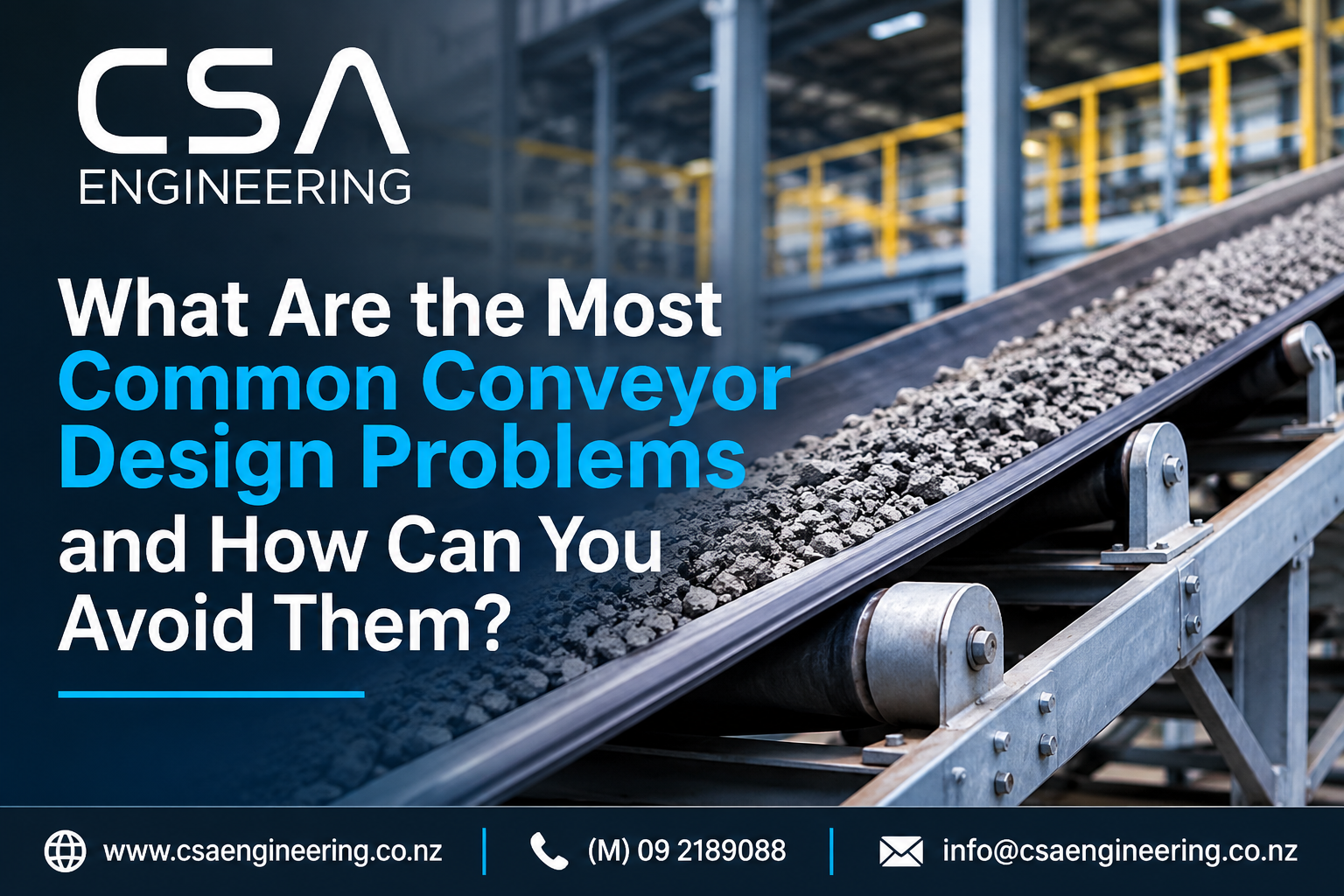
Picture a Monday morning shift at a dairy processing plant. The belt feeding the packing hall stops mid-run. The motor is fine. The belt is fine. The real cause is a decision made two years earlier, when nobody asked what the frame would face once throughput went up.
Stories like this are common across New Zealand, from quarries and sawmills to ports and cold stores. Most conveyor design problems are not freak events. They are predictable gaps left open during design. This article walks through the conveyor design problems that show up most often in industrial settings here, what sits behind each one and how to close the gap early. If you are planning a new line or doubting an old one, specialists in conveyor design can check these points before they turn into downtime.
What Are the Most Common Conveyor Design Problems in New Zealand?
The most common conveyor design problems are loads based on averages, structures that ignore earthquake forces, poorly sized belts and drives, jam-prone transfer chutes, guarding added late, and no safe maintenance access. Nearly all trace back to missing design data and no independent check before fabrication.
New Zealand adds its own pressures. Aggregate, logs, grain and meat vary widely in weight and moisture. Plants sit in seismic zones and often near the coast, where corrosion bites. Many sites also run lean, so a conveyor modified in a hurry is rarely rechecked.
Conveyor Design Problems That Start With the Structure
Earthquake forces left out
A gallery or trestle carrying a loaded belt is a heavy mass on a tall frame. Checked for gravity alone, it can look generous. Add lateral earthquake actions and the picture changes, especially at connections and base plates.
The fix: Include earthquake actions from NZS 1170.5 alongside wind and gravity in the structural model, and design connections to carry them. Early input from experienced structural engineering consultants helps get the load path right before steel is ordered.
Steelwork sized for weight alone
Frames are often sized for the dead load of belt and product and little else. Idler vibration, belt tension pull, walkway loads and coastal corrosion all wear a structure down. The early signs are small: a cracked weld, a loose bolt, a belt that will not track. Left alone, they spread.
The fix: Check steelwork to NZS 3404 using combined load cases. Look at foundations too, because a settling footing can twist a long conveyor out of line.
Conveyor Design Problems in the Mechanical Layout
Loads based on averages
Throughput on a datasheet describes a good day. Real flow arrives in surges, and bulk density shifts with the weather. A conveyor sized for the average spends its life overloaded at the peaks.
The fix: Collect peak rate, density range, lump size, moisture and temperature up front, then design for the worst credible case.
Belt tension and slip
Too little tension and the belt slides on the drive pulley and stalls. Too much and bearings, shafts and splices pay the price. Many designs check steady running only, yet the worst tension often appears at start-up or during an emergency stop.
The fix: Calculate all three conditions and position the take-up to control them.
Drives and shafts under real duty
A motor that handles running load may still struggle to start a fully loaded belt, particularly on an incline. Shafts with sharp keyway corners can crack from repeated stress cycles, often with little warning.
The fix: Check starting torque and shaft fatigue, not just peak strength. A mechanical engineering consultancy can test these choices against the real duty cycle before parts are ordered.
Transfer points that jam
Transfer points are where mistakes show up fast. A chute angle that is too shallow lets sticky product hang up. Too steep, and material hits the belt hard and off-centre, wearing it out and throwing dust.
The fix: Shape the chute around the actual product, not a generic one, and leave room for liners and inspection. Treat the conveyor as one part of the wider plant, since feeders, screens and hoppers all change what arrives.
Conveyor Design Problems Around People and Safety
Guarding added as an afterthought
Nip points, long exposed runs and pull-cords that cannot be reached from where a worker stands are classic findings. Guards bolted on late are awkward to remove, so they get left off.
The fix: Design guarding and emergency stops in from the start, following the AS/NZS 4024 series and using AS 1755 as a recognised conveyor benchmark. Under the Health and Safety at Work Act 2015, those who design plant carry duties too, so keep a record of the safety review.
No safe way to maintain it
Idlers, scrapers and pulley lagging wear out on a schedule. If reaching them means a ladder and a stretch, the work gets delayed or done unsafely.
The fix: Plan walkways, handrails, stairs and lifting points while the layout can still move, and make sure access platforms are properly engineered and certified.
Why Do Conveyor Design Problems Keep Coming Back?
Three habits sit behind most cases. Design data is gathered late. Mechanical, structural and safety work happens in separate silos. And changes are made without going back to the original calculations.
Take a conveyor moved to a new site and switched from dry to wetter product. The belt, drives and frame were all designed for something lighter. The original design was sound. The new duty simply fell outside it.
A Practical Checklist Before You Sign Off a Conveyor Design
Ask these questions before fabrication starts:
- Are peak throughput and worst-case material condition written down?
- Were earthquake and wind actions included in the structure?
- Has belt tension been checked at start-up and during stopping?
- Can every guard be removed for maintenance and still not be run without?
- Can crews reach every roller, scraper and pulley safely?
- Are drawings, calculations and certificates filed for audits?
If any answer is no, bring in industrial engineering services to verify the design before steel is cut. A fresh set of qualified eyes finds what the original team is too close to see.
Which Standards and Rules Apply in New Zealand?
Conveyor design here draws on several references rather than one. WorkSafe New Zealand is the regulator, and the main references are:
- Health and Safety at Work Act 2015: duties for those who design, supply and run plant
- NZS 3404: steel structures
- AS/NZS 1170 and NZS 1170.5: loads, including earthquake actions
- AS/NZS 4024 series: machinery safety
- AS 1755: a widely used conveyor safety benchmark
Meeting these is a floor, not a goal.
Conclusion
Most conveyor design problems can be spotted on paper if someone looks. Missing earthquake loads, averaged-out flow, rushed guarding and blocked maintenance access are all cheaper to fix before steel is cut. If your plant is planning a new line or wondering about an old one, talk to the CSA Engineering team, which provides engineering design services across New Zealand, and get your conveyor design reviewed before the next shift depends on it.
FAQs
Who is responsible for safe conveyor design in New Zealand?
Duties fall on designers, suppliers and the business that runs the plant under the Health and Safety at Work Act 2015. A documented design review helps show that each party did its part.
How do earthquakes affect conveyor design?
They add sideways forces to frames, supports and connections that gravity checks do not cover. Structures should be assessed against NZS 1170.5.
Why does a conveyor belt run off track?
Common design causes include misaligned frames, settling foundations and uneven loading at the transfer point.
Can a conveyor from another site be reused?
Often yes, but it needs a fresh engineering review for the new product, loads, layout and local earthquake and safety requirements.